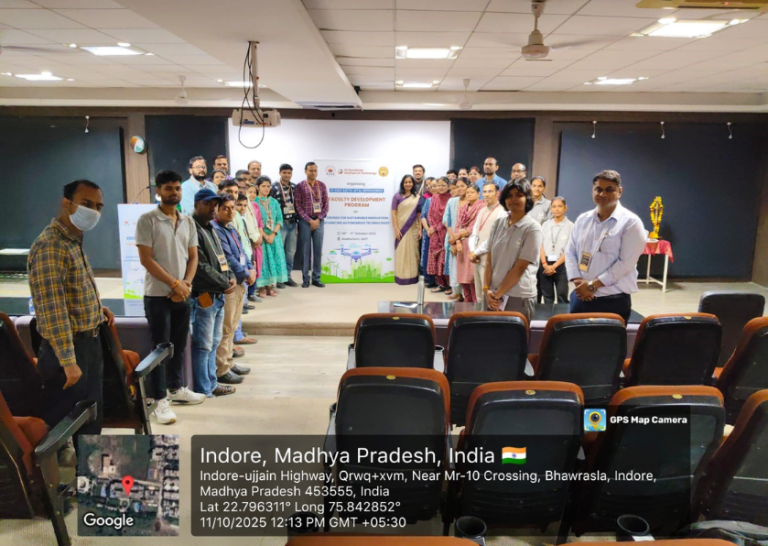
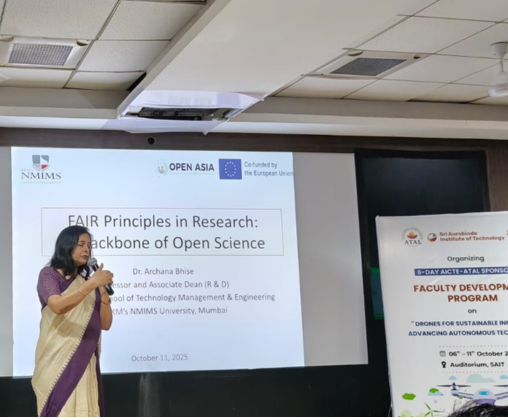
A one-week Faculty Development Programme was organized by Sri Aurobindo Institute of Technology, Indore, from 6th to 11th October 2025. As part of this initiative, Dr. Archana Bhise, Professor and Associate Dean (R&D), Mukesh Patel School of Technology Management & Engineering (MPSTME), SVKM’s NMIMS University, Mumbai, conducted a session on 11th October, 2025, on the topic “FAIR Principles in Research: A Backbone of Open Science.”
The session aimed to enhance participant’s understanding of the ethical and practical aspects of managing and sharing research data in line with global open science standards. Dr. Bhise emphasized how the ‘FAIR principles- Findable, Accessible, Interoperable, and Reusable’ form the foundation of transparent, trustworthy, and collaborative research.
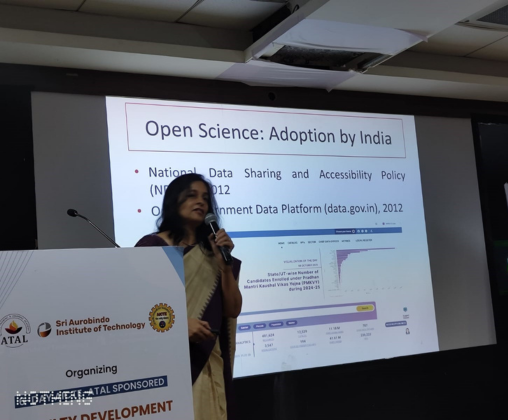
She highlighted India’s commitment to Open Science through initiatives such as the
- National Data Sharing and Accessibility Policy (2012),
- Open Government Data Platform (data.gov.in),
- National Research Data Repository (2016),
- Anusandhan National Research Foundation Act (2023), and
- One Nation One Subscription (2025)
all aimed at enhancing the visibility and reusability of publicly funded research.
Dr. Bhise also addressed key ethical considerations including privacy, consent, equity, and responsible reuse, stressing that openness must balance transparency with ethical responsibility.
The session concluded with an overview of the ERASMUS+ Open Asia Project, funded under the Erasmus+ programme of the European Union (Grant No. 101128493) and coordinated by Universiti of Malaya, is a three-year initiative (2024-2026) aimed at boosting engagement of higher-education institutions in India and Malaysia with Open Science practices.
Through a consortium of nine partner institutions across Europe and Asia, the project supports institutional transition to sustainable Open Science models, development of open-science infrastructure and policy, capacity-building, and dissemination activities.
Overall, the session inspired participants to adopt FAIR principles in their research endeavours, fostering a culture of openness, collaboration, and ethical integrity.